
Victoria Tower
Named after Queen Victoria, Victoria Tower was for many years the tallest and largest stone square tower in the world, with a height of 98.5 metres (325 feet).
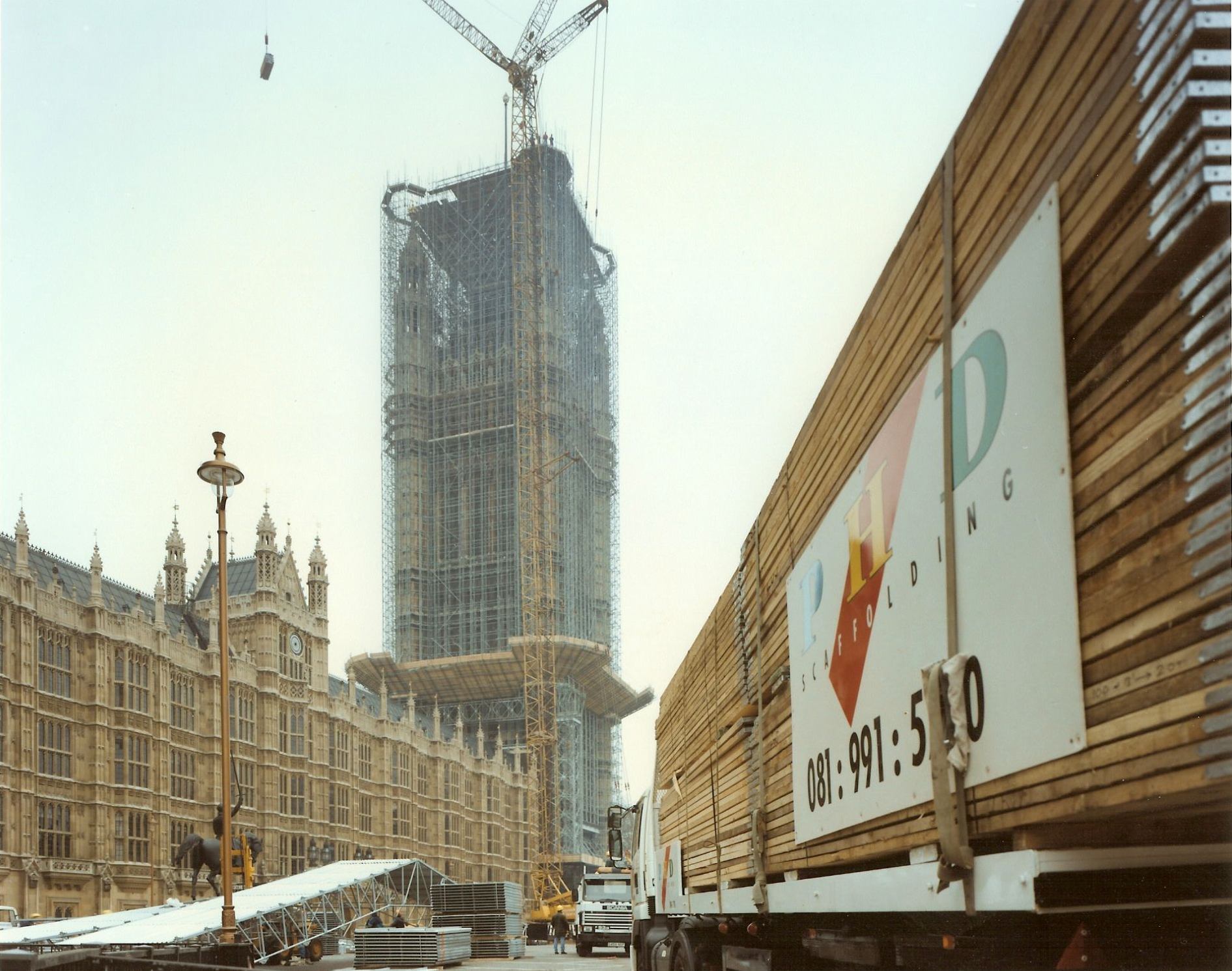
Restoration of the tower was a 4 year process and required over 68 miles of scaffolding tube to provide access to replace 1,000 cubic feet of decayed stonework.
Requirements
The Victoria Tower presented a challenge to the Caretakers. Smog and exhaust fumes were having a chemical effect on the stone – causing it to decay. An earlier attempt, in the 1960s, to provide scaffold around the Tower had proved difficult due to the loads that needed to be imposed. By 1989 the structure was becoming dangerous with several of the ornamental gargoyles vulnerable to falling off.
Speciality
The Parliamentary Works Office went to the market and some of Britain’s finest engineers and scaffold companies attempted to find a solution in providing access to the structure. After 6 months, PHD was engaged in an effort to seek answers on how a scaffold could be offered up to the façade of the building. PHD tendered the Military Truss solution.
Other Challenges
Other challenges were that the Architects and Caretakers would not allow any penetration of the building from mechanical ties. Indeed, PHD was told that they could not use Butt Tubes to touch the façade. An innovative system of piles was therefore designed by PHD, strategically placed to a depth of 26m.
Three military truss towers were erected to carry the primary scaffold. Scaffold could not be attached to the adjoining House of Lords, so PHD engineered two 45m truss spans were used to bridge over the lower buildings. of 26m. Consequently, PHD provided a 120m high free-standing scaffold to the top of the flagpole with a 35m x 35m span temporary roof covering. Stability was achieved via a system of plan braces and 20mm guy wire ropes strategically placed diagonally over the parapet level. The vertical standards had to be tripled to carry the loads imposed.
To position the roof, PHD brought in the largest crane in Europe (at the time) from Antwerp. Thirty seven vehicles, under police escort, were used to transport the crane. PHD also conducted the lifting operation and traffic management system which involved closing off
Parliament Square and the adjoining streets.
Project Data
Location
London
London
Client
Westminster
Westminster
Contractor
PHD Access
PHD Access

